From Henry Ford's Black to Neon Dreams: How Car Colors Became America's Loudest Statement
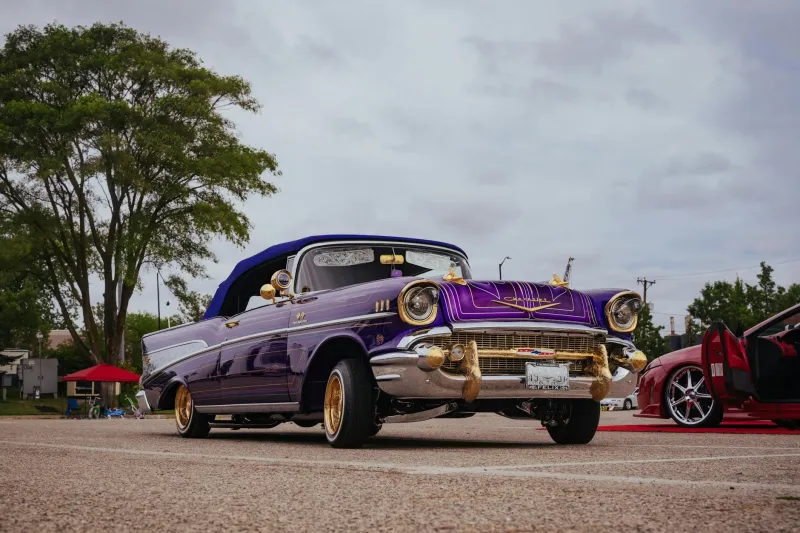
When Black Was Your Only Choice
Henry Ford's famous declaration that customers could have a Model T "in any color so long as it's black" wasn't just a quirky business philosophy—it was the reality of American car ownership for the better part of three decades. From 1908 to 1927, the assembly line demanded uniformity, and color variety was seen as an expensive luxury that would slow production and confuse buyers.
The reasoning was purely practical. Black paint dried faster than other colors, allowing Ford's revolutionary assembly line to maintain its breakneck pace. Other manufacturers followed suit, creating a landscape where American roads looked like a parade of identical black beetles crawling across the countryside.
But Ford's monopoly on automotive thinking was about to crack, and with it, the era of colorless driving.
The Great Color Awakening of the 1920s
General Motors struck the first blow against automotive monotony when they introduced the "True Blue" Oakland in 1918, followed by a expanding palette that would revolutionize how Americans thought about their cars. By the mid-1920s, GM was offering vehicles in colors that had names like "Arizona Beige" and "Versailles Violet"—suddenly, your car could match your personality instead of just your neighbor's.
This wasn't just about aesthetics. The introduction of color choice represented a fundamental shift in American consumer culture. For the first time, car buyers could express individual taste through their vehicle, transforming the automobile from a purely functional tool into a statement piece.
Ford, stubbornly clinging to black, watched their market share plummet from 55% in 1921 to just 15% by 1926. The message was clear: Americans wanted choice, and they were willing to pay for it.
The Pastel Paradise of Post-War America
The 1950s exploded with automotive color like a teenager's bedroom. Pink Cadillacs, turquoise Thunderbirds, and coral Chevrolets cruised through suburbs that were themselves painted in optimistic pastels. This was America flexing its post-war prosperity, and car colors became a symbol of the nation's confidence and economic boom.
Manufacturers introduced two-tone paint schemes that would make today's designers blush. The 1955 Buick Century could be ordered in "Riviera Blue and Polo White," while Plymouth offered combinations like "Belmont Blue and Cloud White." These weren't just cars—they were rolling art installations that announced their owner's participation in the American Dream.
But the color explosion of the '50s was still limited by technology. Paint chemistry restricted manufacturers to specific formulations, and custom colors remained the exclusive domain of the wealthy. Most Americans chose from a palette of perhaps a dozen options, all predetermined by Detroit's design committees.
The Beige Backlash and Corporate Conservatism
Something strange happened in the 1970s and '80s. As Americans faced economic uncertainty, gas crises, and social upheaval, their car color choices became increasingly conservative. Beige, tan, and various shades of brown dominated showrooms, creating what automotive historians now call the "Malaise Era" of car colors.
This wasn't coincidence—it was psychology. During uncertain times, consumers gravitated toward colors that felt safe, practical, and unlikely to go out of style. Car manufacturers, reading the market, doubled down on neutral tones that appealed to the broadest possible audience.
The result was a automotive landscape that looked like it had been dipped in coffee. White, silver, and various earth tones accounted for nearly 80% of all car sales during this period, creating highways that looked more like corporate parking lots than expressions of American individualism.
The Digital Revolution: Infinite Possibilities
Today's car color options would seem like magic to a 1950s buyer. Computer-controlled paint systems can create virtually any shade imaginable, while new technologies like color-shifting paints, matte finishes, and vinyl wraps have transformed vehicles into canvases for personal expression.
Want your Tesla to change colors with your mood? There's a wrap for that. Prefer a finish that looks like brushed metal? Paint technology can deliver. Some luxury manufacturers now offer paint-to-sample programs where customers can match their car to literally anything—a favorite lipstick, a sunset photograph, even a pet's fur.
The numbers tell the story of this revolution. While 1970s buyers chose from perhaps 15 factory colors, today's consumers can select from hundreds of standard options, thousands of special-order finishes, and virtually unlimited custom possibilities through aftermarket modification.
Beyond Color: Cars as Personal Billboards
What's really changed isn't just the availability of colors—it's what we expect our cars to communicate about us. In Ford's era, a car was transportation. Today, it's a rolling autobiography that broadcasts our values, aspirations, and tribal affiliations to everyone we pass on the highway.
Social media has amplified this trend. Instagram-worthy paint jobs drive sales of exotic finishes, while YouTube influencers showcase color-changing wraps that would have been pure science fiction just two decades ago. The car has become perhaps the largest personal accessory most Americans will ever own, and we treat it accordingly.
The Future Spectrum
As we stand on the edge of the electric vehicle revolution, car colors are evolving again. Tesla's minimalist palette reflects tech-world aesthetics, while traditional manufacturers experiment with colors that highlight their vehicles' environmental credentials—think "sustainable blue" and "eco-friendly green."
Some futurists predict that future vehicles will feature dynamic color-changing capabilities, allowing drivers to alter their car's appearance at will. Others suggest that autonomous vehicles might eliminate color choice entirely, returning us to a world where function trumps form.
But if history teaches us anything, it's that Americans will always find a way to make their cars reflect their personalities. The journey from Henry Ford's utilitarian black to today's rainbow of possibilities isn't just about paint technology—it's the story of how we learned to see our vehicles as extensions of ourselves, and how the simple act of choosing a color became one of the most personal decisions we make.