The Network That Connected Everything
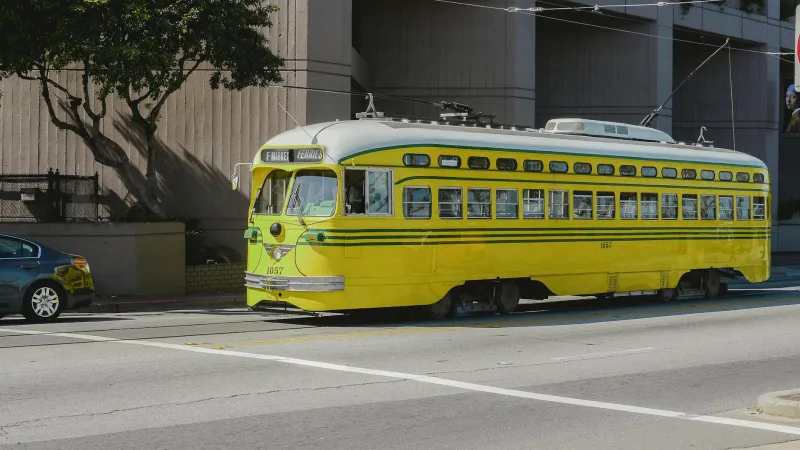
In 1945, Rosa Martinez could leave her apartment in East Los Angeles, drop a dime into the fare box of a Pacific Electric streetcar, and arrive at her job in downtown LA twenty-five minutes later. After work, she could transfer to another line and meet friends in Hollywood for fifteen cents total. On weekends, the same system could take her to the beach in Santa Monica, the mountains in Altadena, or shopping in Pasadena—all without owning a car or even thinking about owning one.
Rosa wasn't unusual. Millions of Americans in cities across the country lived this way, moving through comprehensive transit networks that connected neighborhoods, jobs, and entertainment with the efficiency that today's app-based systems promise but rarely deliver. The difference was that these networks were built to serve everyone, not just people wealthy enough to afford surge pricing.
When Public Transit Was Actually Public
The scale of America's pre-war transit systems is difficult to grasp today. Los Angeles alone had over 1,000 miles of electric streetcar lines—more than the current subway systems of New York, Washington DC, and San Francisco combined. Detroit, Cleveland, and dozens of smaller cities had networks that could get you from any neighborhood to any other neighborhood for the price of a candy bar.
These weren't just downtown shuttles or commuter lines for office workers. They were comprehensive transportation systems that connected residential neighborhoods to factories, shopping districts, entertainment venues, and each other. A typical working-class family could live comfortably without a car because public transit actually went where people needed to go, when they needed to go there.
The frequency was remarkable by today's standards. In major cities, streetcars and buses ran every few minutes during peak hours, every ten to fifteen minutes during off-peak times. You didn't need to check schedules or plan your day around transit timetables—you just walked to the nearest stop and waited.
The Economics That Made Sense
A transit ride in 1945 cost about the same as a phone call or a newspaper—pocket change that even minimum-wage workers could afford multiple times per day. Adjusted for inflation, that dime fare would equal roughly $1.50 today. Compare that to current public transit costs: $2.75 for a subway ride in New York, $3.50 for a bus in Los Angeles, $15-30 for an Uber trip across town.
But the real economic advantage wasn't the low fares—it was that the system made car ownership optional rather than mandatory. Families could participate fully in urban life, hold jobs, go shopping, visit friends, and attend entertainment without the enormous fixed costs of buying, insuring, maintaining, and parking an automobile.
This wasn't just convenient for individuals—it was economically efficient for society. One streetcar could move as many people as fifty cars while using a fraction of the street space, requiring no parking lots, and producing no emissions. Cities could build more densely because they didn't need to accommodate parking for every building.
The Great Dismantling
What happened next is one of the most dramatic infrastructure reversals in American history. Between 1945 and 1970, cities across the country systematically dismantled their transit systems. Streetcar lines were torn up, electric buses were replaced with diesel ones, and entire networks that had served millions of people simply disappeared.
The official story was that Americans preferred cars and suburbia, that transit was old-fashioned and inefficient. But the reality was more complex. Federal highway funding made car-oriented development artificially cheap. Zoning laws mandated parking minimums that made dense, transit-friendly development illegal. And in some cases, transit companies were literally bought by automobile and oil companies and shut down.
General Motors, along with Firestone Tire and Standard Oil, formed a company called National City Lines that purchased streetcar systems in dozens of cities, converted them to buses, then deliberately let service deteriorate until ridership collapsed. They were eventually convicted of conspiracy in federal court, but by then the damage was done.
The Suburban Experiment
The new model was supposed to be better: every family would own a car, live in a house with a yard, and drive to work, shopping, and entertainment. Cities built highways instead of streetcar lines, shopping malls instead of downtown districts, and subdivisions instead of walkable neighborhoods.
For a generation, it seemed to work. Cars provided freedom and flexibility that transit couldn't match. Suburban homes were larger and newer than urban apartments. Parking was free and abundant. The American dream had wheels and a two-car garage.
But the hidden costs accumulated over decades. Car-dependent development required massive public investments in roads, highways, and parking infrastructure. Families had to buy multiple cars instead of sharing public transit. Low-density suburbs made every trip longer and more expensive. The poor, elderly, and disabled were effectively excluded from communities designed around car ownership.
The App-Based Renaissance
Today's ride-sharing apps are often celebrated as transportation innovation, but they're actually trying to solve problems that didn't exist seventy years ago. Uber and Lyft provide on-demand transportation in cities that deliberately dismantled their on-demand transportation systems. The algorithms that route drivers efficiently are recreating the comprehensive coverage that streetcar networks once provided automatically.
The irony is striking: we're using cutting-edge technology to rebuild inferior versions of systems we once had. A 1950s streetcar could move fifty people for the environmental cost of a single Uber ride. The old transit systems had dedicated right-of-way that avoided traffic congestion. They were accessible to people with disabilities, reliable in bad weather, and affordable for minimum-wage workers.
Modern ride-sharing is more convenient in some ways—you can summon a car to your exact location with a smartphone app. But it's also more expensive, less environmentally efficient, and completely dependent on private companies that can change prices or service levels at will.
What We're Still Missing
The most important difference between America's old transit systems and today's alternatives isn't technological—it's philosophical. The streetcar networks were built as public utilities, designed to serve entire communities regardless of income level. Today's transportation apps are built as private businesses, designed to maximize profit from customers who can afford premium prices.
This fundamental difference shapes everything: route planning, pricing, service quality, and accessibility. Public transit was subsidized because cities understood that transportation access was essential for economic participation. Private ride-sharing is market-priced because companies need to generate returns for investors.
The Road Not Taken
Imagine if America had continued investing in and modernizing its transit systems instead of dismantling them. Today's cities might have electric streetcars with smartphone integration, comprehensive networks that connected every neighborhood, and fare systems that made transportation affordable for everyone.
Instead, we're trying to solve 21st-century transportation problems with a patchwork of expensive apps, aging bus systems, and the assumption that everyone should own a car. We're rediscovering, one ride-sharing trip at a time, that the comprehensive transit networks we deliberately destroyed actually worked better than the car-dependent system that replaced them.
The next time you pay surge pricing for an Uber ride or wait twenty minutes for a bus, remember Rosa Martinez dropping her dime into that streetcar fare box in 1945. She was using technology we're still trying to reinvent.