When Families Fought Over One Button: The Car Radio Revolution That Split America's Backseat
The Great Radio Wars of 1962
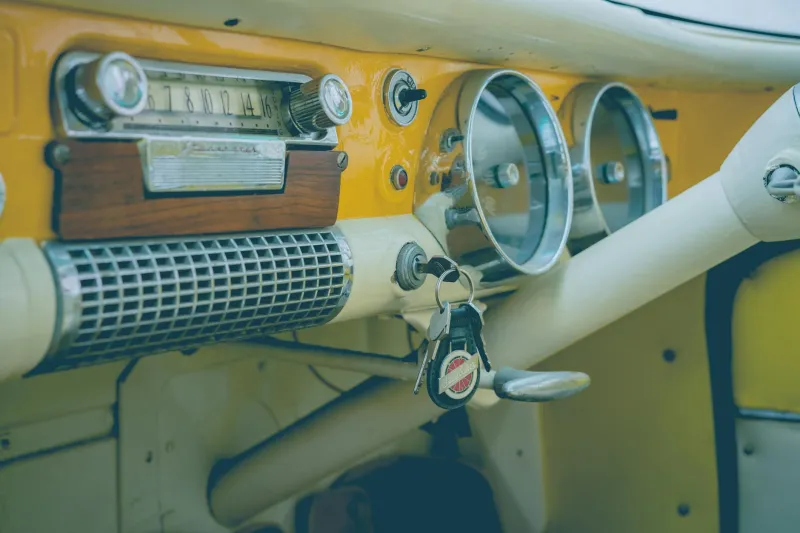
Picture this: It's 1962, and the Johnson family is driving from Cleveland to Niagara Falls in their brand-new Chevrolet Impala. Dad's got his hand firmly planted on the radio dial, searching through static for a baseball game. Mom wants Perry Como. The kids are begging for rock and roll. There's exactly one speaker, one volume knob, and one frequency selector—and everyone has an opinion about what should come through it.
This wasn't just background noise to a road trip. This was the soundtrack to American family democracy in action, played out on AM radio waves across thousands of miles of highway.
When One Knob Ruled the Dashboard
For the first half of the 20th century, car entertainment was brutally simple. Most vehicles came equipped with a basic AM radio featuring a single tuning dial and volume control. If you were lucky enough to own a car with an FM band by the late 1960s, you had access to maybe a dozen clear stations on a good day.
Families developed elaborate negotiation systems around radio time. Dad controlled the dial during news hours. Mom got her music during scenic stretches. Kids might get fifteen minutes of their "noise" if they promised to behave for the next hundred miles. The car radio wasn't just technology—it was a lesson in compromise, patience, and the art of shared experience.
Every family road trip included at least one heated discussion about whether to endure static for a distant station or settle for whatever came through clearly. These weren't minor disagreements. These were passionate debates about the fundamental question of whether it was better to suffer through Lawrence Welk or risk losing the signal entirely while searching for something better.
The Cassette Revolution Changes Everything
When 8-track players arrived in the late 1960s, followed by cassette decks in the 1970s, the balance of power shifted dramatically. Suddenly, families could bring their own music along for the ride. But this created new problems: whose tapes made the cut for a family vacation? How many times could you reasonably play "Hotel California" before someone threatened to throw the cassette out the window?
The cassette era introduced the concept of "car music"—songs that worked specifically well during long drives. Families developed traveling playlists decades before algorithms suggested what we might want to hear. Creating the perfect road trip mix became an art form, balancing everyone's preferences while maintaining good driving rhythm.
When CD Players Made Everyone a DJ
By the 1990s, in-car CD players transformed every passenger into a potential DJ. Families started bringing entire collections on vacation. The "CD wallet" became as essential as maps and snacks. But with great power came great responsibility—and greater potential for conflict.
Now families had to negotiate not just what to listen to, but who controlled the six-disc changer rotation. The concept of "shotgun privileges" expanded beyond navigation to include music selection rights. Backseat passengers lobbied for representation in playlist democracy.
The Satellite Split
Satellite radio in the early 2000s seemed like the perfect solution. With hundreds of channels, surely everyone could find something they enjoyed. Instead, it created analysis paralysis. Families spent more time scrolling through options than actually listening to music. The abundance of choice made decision-making more difficult, not easier.
Satellite radio also introduced the concept of "premium audio" in family cars. Suddenly, there were channels you paid extra to access, creating new hierarchies around who deserved the good stuff during road trips.
The Smartphone Takeover
Then came smartphones, Bluetooth connectivity, and streaming services. Today's family car offers unlimited entertainment options. Every passenger can access millions of songs, thousands of podcasts, and endless audio content. Parents can listen to true crime podcasts through the car speakers while kids watch movies on tablets with headphones.
Modern vehicles feature multiple audio zones, allowing different passengers to enjoy completely separate entertainment experiences. Some luxury cars offer individual sound bubbles, where each seat receives customized audio without disturbing others.
What We Lost in Translation
But something fundamental changed when we solved the car radio problem. Those heated family debates over music selection taught negotiation skills. Discovering new songs because Dad refused to change the station created unexpected musical education. Being forced to listen to Mom's standards occasionally broadened everyone's taste.
The shared experience of singing along to the same song—even if nobody really wanted to hear it—created family memories that individual playlists can't replicate. When everyone hears the same thing, everyone participates in the same moment.
The Democracy of Distraction
Today's car entertainment eliminates conflict by eliminating interaction. Each passenger retreats into their personal audio world, connected to their own content stream. We've traded family democracy for individual autonomy, communal experience for personalized perfection.
Modern road trips often feature families sitting inches apart while consuming completely different media. The car has become less of a shared space and more of a mobile living room where everyone watches their own screen.
The Sound of Progress
The evolution from one radio knob to infinite entertainment options represents remarkable technological progress. Families no longer suffer through static or endure unwanted music. Everyone gets exactly what they want, when they want it.
But we might wonder whether solving the car radio problem eliminated something valuable along the way. Those arguments over the dial weren't just about music—they were about learning to coexist in close quarters, finding common ground, and occasionally discovering that other people's choices weren't as terrible as we initially thought.
The car radio revolution gave us unlimited options and perfect personal control. Whether we're better off depends on what we think family road trips are supposed to accomplish—and whether the destination matters more than what happens along the way.