When Getting Lost Was Part of Getting There: The Death of America's Navigation Instincts
The Night Before the Journey
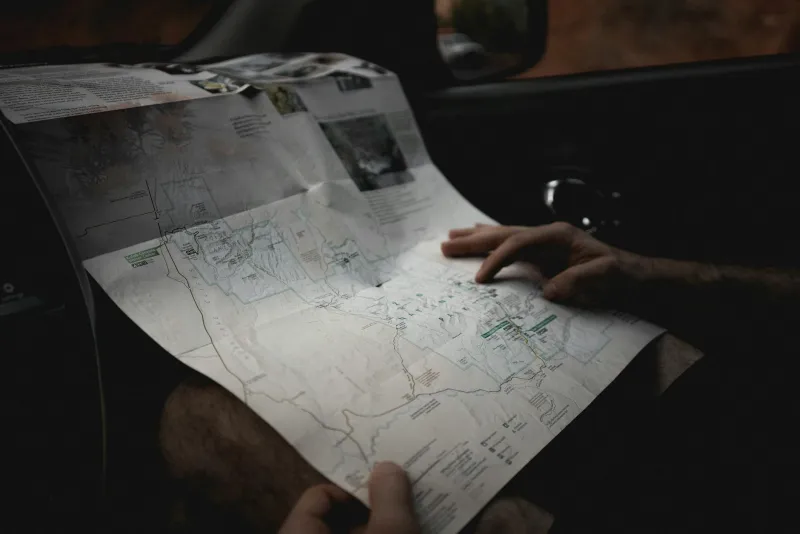
Picture this: It's 1985, and you're planning a weekend trip from Chicago to Milwaukee. You spread a Rand McNally road atlas across your kitchen table, tracing possible routes with your finger. Interstate 94 looks straightforward, but what about that smaller highway that cuts through lake country? You scribble notes on a piece of paper—"Exit 42 toward Kenosha," "Watch for the water tower after the Chevron."
This wasn't just trip planning. It was cognitive preparation that would shape how your brain understood geography for decades to come.
Today, that same journey requires zero mental preparation. You tap "Milwaukee" into your phone, and a blue line appears. No atlas consultation, no landmark memorization, no backup route consideration. Just blind faith in a satellite constellation 12,000 miles overhead.
The Lost Art of Spatial Memory
Before GPS became standard equipment around 2010, American drivers developed what researchers now call "cognitive mapping"—the brain's ability to construct detailed mental representations of physical space. This wasn't just about knowing directions; it was about understanding relationships between places, distances, and alternative routes.
Driving to work every day, you'd notice the gas station where traffic always backed up, the shortcut through the residential neighborhood, the hill where your car struggled in winter. These observations built a rich, three-dimensional understanding of your world that existed entirely in your head.
Neuroscientist Dr. Véronique Bohbot's research at McGill University reveals something startling: people who rely heavily on GPS show measurably less activity in the hippocampus—the brain region responsible for spatial memory and navigation. It's not just that we've become dependent on technology; we've actually altered our neural pathways.
When Wrong Turns Taught Right Lessons
Getting lost used to be an education. Take a wrong turn in 1990, and you'd have to figure your way out using street signs, the sun's position, maybe a gas station attendant's directions. Each mistake became a data point, strengthening your mental map and building confidence in your ability to navigate independently.
Modern drivers experience something entirely different. When GPS recalculates after a missed turn, there's no learning curve, no problem-solving, no spatial reasoning required. The technology corrects our mistakes so efficiently that we never develop the skills to correct them ourselves.
This has created what researchers call "learned helplessness" in navigation. Studies show that people who've grown up with GPS often can't find their way home if their phone dies, even on routes they've driven hundreds of times.
The Paper Map Advantage
Fold out a paper map, and you're forced to understand context. You see where you're going in relation to everything else—neighboring cities, geographic features, the broader transportation network. GPS shows you exactly one thing: the next turn.
This difference matters more than most people realize. When you understand the "why" behind a route—why it curves around that lake, why it avoids that mountain range—you develop what geographers call "spatial intelligence." You begin to predict where roads might go, understand traffic patterns, and develop intuitive backup plans.
London taxi drivers, who must memorize the city's 25,000 streets to earn their license, show enlarged hippocampi on brain scans. Their brains literally grow to accommodate spatial knowledge. American drivers, increasingly, show the opposite trend.
What We Traded Away
The efficiency gains from GPS are undeniable. Average Americans save hours per week that would have been spent consulting maps, asking for directions, or simply being lost. But efficiency isn't the only metric that matters.
We've traded spatial confidence for convenience. The ability to explore without fear, to take interesting detours, to develop an intuitive sense of direction—these skills atrophy when not used. Many young drivers today experience genuine anxiety at the thought of driving without GPS, even in familiar areas.
There's also the question of what happens when the technology fails. Solar flares can disrupt satellite signals. Cyberattacks could target GPS infrastructure. Natural disasters often knock out cell towers. In any of these scenarios, a generation of Americans who've never learned to navigate independently could find themselves genuinely helpless.
The Neuroscience of Getting There
Recent studies using brain imaging technology reveal that GPS navigation and traditional wayfinding activate completely different neural networks. Traditional navigation engages the prefrontal cortex (decision-making), the hippocampus (spatial memory), and the parietal cortex (spatial awareness) in complex coordination.
GPS navigation, by contrast, activates primarily the caudate nucleus—the brain's "autopilot" system used for following learned sequences. It's the same neural pathway used for habits like brushing your teeth or tying your shoes. Functional, but not intellectually engaging.
This shift has implications beyond just getting from point A to point B. Spatial reasoning skills correlate with mathematical ability, architectural thinking, and even certain types of creativity. When we outsource navigation to machines, we may be outsourcing cognitive development itself.
Finding Our Way Forward
This isn't an argument for throwing away smartphones and returning to paper maps. GPS technology has made driving safer, more efficient, and more accessible to people with various disabilities. But perhaps it's worth occasionally choosing the harder path.
Try driving a familiar route without GPS. Study a paper map before a long trip. Take deliberate wrong turns just to see where they lead. These small acts of spatial rebellion might seem inefficient, but they exercise cognitive muscles that evolution spent millions of years developing.
After all, the human brain's navigation system is one of our species' most remarkable achievements. It seems worth preserving, even in an age when satellites can do the thinking for us.
The road ahead might be clearly marked by GPS, but the journey of understanding where we're going—and how we got there—remains ours to navigate.