Burma Shave Signs and Motor Lodges: What the American Road Trip Used to Actually Be About
Burma Shave Signs and Motor Lodges: What the American Road Trip Used to Actually Be About
Somewhere between the rise of Google Maps and the arrival of the interstate rest stop, the American road trip changed in ways most of us haven't fully stopped to consider. It didn't just get faster or more efficient. It became something fundamentally different — a means to an end rather than an end in itself.
For a generation of Americans who loaded up the station wagon in the 1950s, 60s, and 70s, the drive was the vacation. Not the destination.
The Road as Entertainment
Before the highway system was fully built out, American roads were lined with an almost theatrical collection of diversions designed to capture the attention — and the dollars — of passing motorists. Burma-Shave signs ran in sequence along rural routes, delivering punchline-style rhymes across a quarter mile of fence posts. Giant fiberglass animals marked the entrance to roadside zoos. Souvenir shops sold painted rocks and miniature license plates. Mystery spots claimed to defy gravity. Alligator farms sat alongside peach orchards.
These weren't sophisticated attractions. They were deliberately, cheerfully tacky — and that was the appeal. Families would pull over on a whim. There was no review to check, no star rating to consult. You stopped because the sign looked interesting, or because the kids were restless, or because your dad had heard about it from a guy at work.
That spontaneity was built into the experience. You didn't plan every stop. You discovered them.
Sleeping Where You Landed
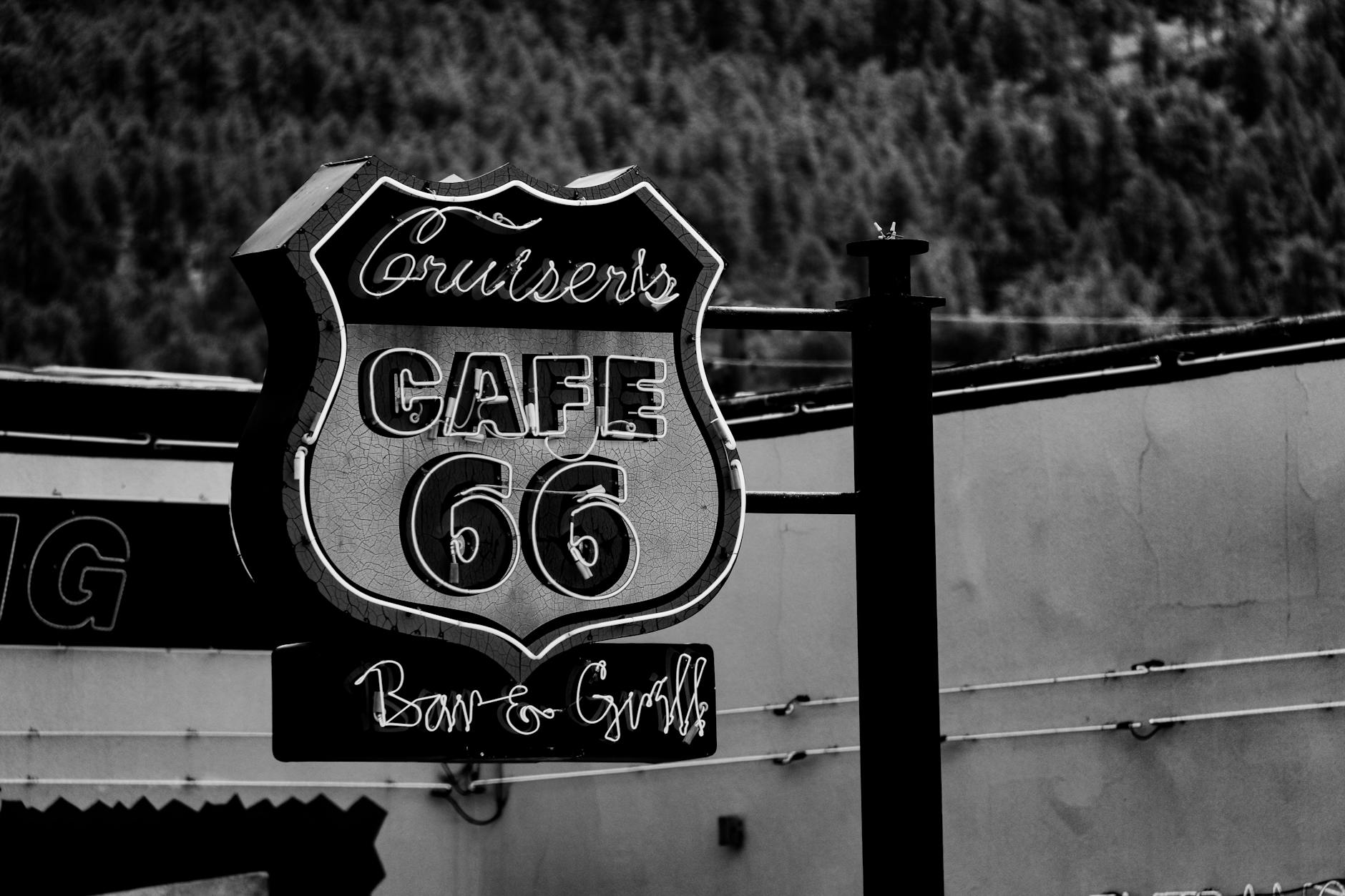
The motor lodge — later called the motel — was purpose-built for the road-tripping American family. Unlike the grand hotels of city centers, motor lodges sat right on the highway, their neon signs visible from a quarter mile away, promising vacancy and a parking spot right outside your door.
Chains like Holiday Inn, Howard Johnson's, and Ramada grew into household names precisely because they offered something new: predictability. You knew roughly what you were getting. But even within that framework, the experience of finding a room was fundamentally analog. You pulled in, walked to the front desk, and asked if they had space. No app, no instant booking, no confirmation email. If they were full, the clerk might know the next decent place down the road and point you in that direction.
There was a social texture to it. Families met each other at the pool. Truckers ate at the same diner counter as vacationers. The road created accidental community in ways that a private Airbnb rental simply doesn't replicate.
The Interstate's Bargain
When the Interstate Highway System came together in the 1960s and 70s, it made cross-country travel dramatically faster and safer. It also began to hollow out the old road culture. The two-lane routes that had sustained roadside America — US Route 66 being the most famous example — started bleeding traffic to the new interstates.
Business dried up along the old roads. The quirky motor lodges gave way to standardized chain properties clustered around highway exits. The roadside attraction struggled to compete with the sheer speed and efficiency of the new system. Why stop at the world's largest ball of twine when you're already making great time and the kids are quiet?
Convenience, it turned out, was the enemy of serendipity.
The Modern Road Trip
Today's American road tripper operates in a completely different information environment. Before leaving the driveway, most travelers have already mapped their route, identified their overnight stops, pre-booked accommodations, read reviews of every restaurant within a mile of their planned exits, and loaded a playlist.
Apps like GasBuddy optimize fuel stops by price. Yelp and Google Reviews filter dining options by star rating and cuisine type. Waze reroutes around traffic in real time. Even the spontaneous detour has become semi-curated — Atlas Obscura has turned the quirky roadside find into a searchable database.
For electric vehicle owners, the route is increasingly shaped by charging infrastructure. A Tesla driver planning a long trip thinks about Supercharger locations the way a 1965 Buick driver thought about gas stations — except the planning happens on a screen before departure, not on the fly.
None of this is bad. It's genuinely more efficient. You're less likely to end up stranded, overcharged, or eating terrible food. But something has changed in the texture of the experience.
What the Old Road Had That the New One Doesn't
The mid-century road trip operated on a kind of structured uncertainty. You knew roughly where you were going and roughly how long it would take, but the middle part — the actual driving — was genuinely open. You might find something extraordinary. You might find nothing at all. That openness was the point.
Today's road trip is optimized. And optimization, by definition, removes the unexpected. When every stop is pre-reviewed and every route is algorithmically selected, the journey becomes a series of confirmed expectations rather than a sequence of discoveries.
The American road trip hasn't disappeared. Millions of families still pile into their vehicles every summer and head somewhere worth going. But the spirit of the thing — the willingness to follow a hand-painted sign down a gravel road because it said "GIANT CATFISH — 2 MILES" — that's harder to hold onto when your phone already knows exactly what's two miles ahead.
Some things get better when they get more efficient. The road trip might be the exception.