The Week of Guesswork: When a Car Noise Meant a Mystery Instead of a Notification
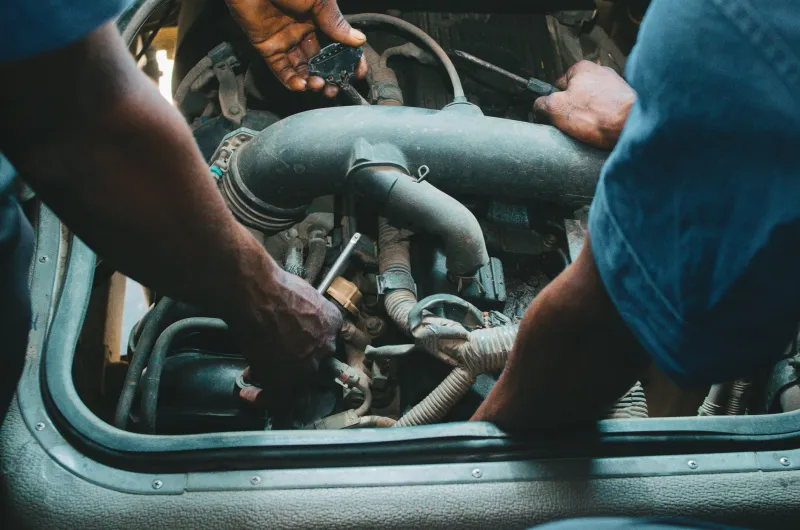
Ask anyone who drove in the 1970s about car trouble and watch their face. They're not remembering the breakdown. They're remembering the week before it — the strange noise that came and went, the theory that it was the alternator, the friend who swore it was the fuel pump, the $60 spent on parts that fixed nothing. Diagnosis used to be a process of elimination conducted over days, sometimes weeks, by people relying on nothing but their ears, their hands, and a stubborn refusal to take the car to a shop until they were sure.
Today, that entire experience has been deleted from American life. Most drivers under 35 have never lived it.
The Stethoscope Era
Well into the 1980s, a car's mechanical condition was essentially invisible. There was no warning light for 'your oxygen sensor is degrading.' There was barely an oxygen sensor at all — the first ones appeared with catalytic converters in 1975 and did their work silently, without reporting anything to the driver.
Mechanics had a toolkit that would look primitive to a modern technician: a timing light, a vacuum gauge, a dwell meter, and the most important instrument of all — a long rubber hose they'd press against engine components and hold to their ear, like a doctor's stethoscope. Literally. Automotive stethoscopes were real tools, sold in catalogs, and using one well was a mark of craft.
A 'tune-up' was an annual ritual for exactly this reason. Cars drifted out of adjustment constantly — carburetors needed rejetting, points needed gapping, timing needed resetting — and the only way to know was either scheduled maintenance or symptoms. You changed the oil every 3,000 miles, got a tune-up every year or two, and hoped. The car couldn't tell you anything. It could only perform, or stop performing.
1996: The Year Cars Started Talking
The turning point came quietly. Starting with the 1996 model year, federal law required all new cars sold in the US to include OBD-II — onboard diagnostics, second generation. Buried in this regulation was something quietly revolutionary: a standardized computer port under every dashboard in America, capable of reporting what was wrong with the vehicle in a common language.
At first, only mechanics had scan tools to read it. But the port was standardized and accessible, and consumer electronics being what they are, it wasn't long before $20 Bluetooth dongles let anyone plug in and read their own car's data. By the 2010s, apps could translate cryptic codes — P0420, anyone? — into plain English. Today, many cars push maintenance alerts to your phone over the cellular network. 'Tire pressure low, front left.' Not a rattle you have to interpret. A notification you can read at breakfast.
The transformation in repair time is hard to overstate. A misfire that once demanded an afternoon of pulling spark plugs and swapping parts in trial-and-error fashion is now a two-minute scan that names the cylinder. Intermittent electrical gremlins — the legendary nightmare of the stethoscope era — can now be logged by the car itself, timestamped, and retrieved later.
Breakdowns Became Appointments
The deepest change isn't speed. It's the character of failure itself.
In the old days, cars failed suddenly and without warning — a belt snapped, a radiator boiled over, and you were on the shoulder of Route 30 waiting for a tow. The breakdown was an event, often a dramatic one. Roadside emergencies were common enough that an entire culture surrounded them: the flares in the trunk, the service stations that stayed open late, the strangers who stopped.
Modern cars rarely surprise you. Sensors detect a weakening battery before it dies. Oil life monitors calculate remaining lubricant capacity from actual driving conditions rather than a fixed mileage. Some vehicles will warn of an impending component failure weeks in advance. The roadside emergency has been converted into a scheduled maintenance appointment — you get an alert, you book a slot, the part is replaced before it fails. The breakdown, as a category of experience, is quietly going extinct.
Something is gained, obviously: safety, reliability, cars that routinely last 200,000 miles. But something subtle went with it. The old system created a nation of amateur diagnosticians — people who could hear the difference between a wheel bearing and a CV joint, who kept a toolbox in the trunk and a Chilton manual on the shelf. That knowledge has been transferred into the machine itself.
The Car That Knows First
There's something a little remarkable about the current state of affairs: your car often knows it's sick before you feel any symptom, and it tells a computer, which tells your phone, which tells you. The machine has become its own physician.
The next time your dashboard politely suggests an oil change in 12 percent, remember that this single sentence contains more diagnostic information than most drivers received in the entire 20th century. The mystery machine has become a machine that removes the mystery — whether or not we ever asked it to.