When Cars Used to Roar: The Slow, Deliberate Silencing of the American Road
Get behind the wheel of a well-engineered modern car — a current-generation luxury sedan, a late-model crossover, even a mainstream family hauler — and close the door. Notice how the outside world disappears. The traffic noise, the wind, the rumble of the pavement — all of it drops to a murmur, then almost nothing. You could be in a well-insulated room. The engine, if it's running at all, is a distant suggestion rather than a mechanical presence.
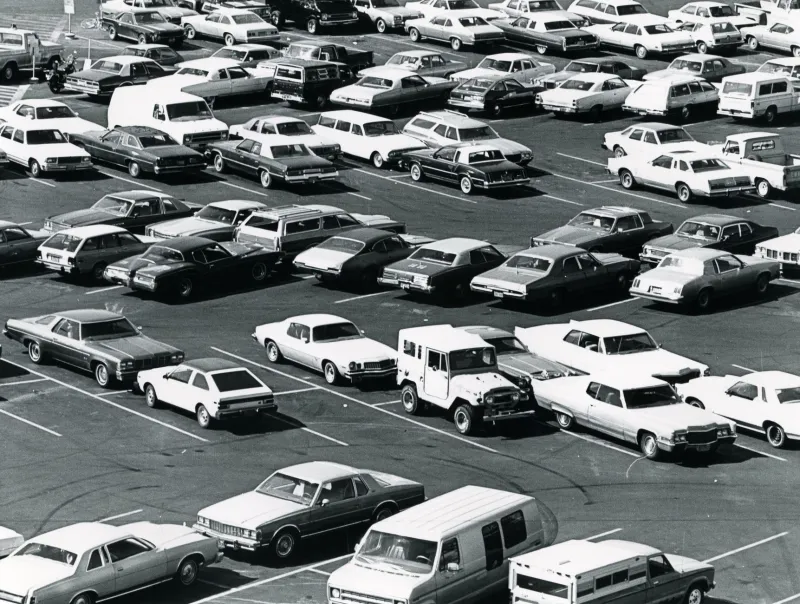
Now think about driving a 1972 Ford F-100 down a Michigan highway. The engine was loud enough that you raised your voice to talk. The cab vibrated with road texture you could feel in your teeth. Wind found its way through the door seals and reminded you, constantly, that you were moving through air at speed. You didn't just drive that truck. You wore it.
The gap between those two experiences is one of the most profound — and least discussed — transformations in American automotive history.
The Original Soundtrack
For most of the twentieth century, driving was a multisensory experience in ways that had nothing to do with infotainment systems or ambient lighting. The car communicated through sound and vibration in a continuous, unfiltered conversation with the road beneath it.
Engine note changed with throttle input. You could hear the carburetor pulling fuel at wide-open throttle in a way that told you something real about what the engine was doing. Tire noise varied with road surface — smooth concrete sounded different from chip-sealed asphalt, which sounded different again from brick or gravel. On a long highway drive, the rhythmic thump of expansion joints in the concrete came through the floorboard like a metronome, marking the miles.
Wind noise increased with speed in a way that gave you a genuine physical sense of velocity. At 70 mph in a 1968 Chevrolet Impala, the air pressure against the windows and the whistle through the door seals told you in no uncertain terms that you were moving fast. There was no acoustic illusion of stillness.
None of this was considered a problem. It was simply what driving felt like.
The Engineering War on Noise
The deliberate suppression of cabin noise began in earnest in the 1960s and accelerated through every subsequent decade. Cadillac made quietness a selling point in the 1950s — "the standard of the world" was partly a promise about how little you'd hear. Lincoln Continental advertising in the 1960s emphasized hushed interiors as a mark of luxury and refinement.
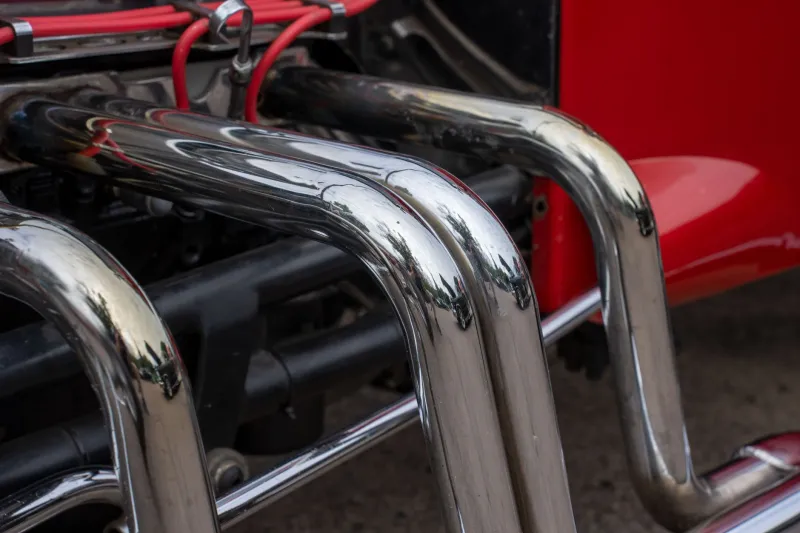
The tools of noise suppression multiplied over the years. Butyl rubber deadening applied to floor pans and door skins. Foam insulation packed around firewall penetrations. Laminated acoustic glass that absorbed high-frequency sound. Engine mounts isolated on rubber bushings that absorbed vibration before it reached the chassis. Exhaust systems tuned not just for emissions compliance but for tonal quality — engineered to produce a specific sound signature rather than simply expelling combustion gases.
By the 1990s, the pursuit of NVH reduction — noise, vibration, and harshness, in the industry's clinical terminology — had become one of the primary metrics by which new vehicles were evaluated. Engineers used decibel meters and accelerometers throughout development to identify and eliminate every unwanted frequency. The modern car's interior acoustic environment is the result of thousands of hours of deliberate engineering work, most of it aimed at removing things rather than adding them.
Electric Vehicles Took It Further
If the internal combustion engine's refinement over decades represented a gradual dimming of the automotive soundtrack, the electric vehicle represents a near-complete blackout.
Without an engine, the dominant sounds inside an EV at city speeds are tire noise and wind — themselves heavily suppressed by modern acoustic glass and carefully shaped body panels. At highway speeds, some road noise intrudes, but the experience is fundamentally different from any gasoline-powered car of any era. Early Tesla drivers reported a disorienting silence that took adjustment. Some found it peaceful. Others found it alienating.
Automakers responded to the silence in ways that would have seemed absurd to a 1970s engineer: by adding artificial sound. Several manufacturers now pipe synthesized engine noise into the cabin through the speaker system, creating a sonic experience that mimics the mechanical feedback the car no longer generates organically. Ford's Mustang Mach-E offers a selectable "engine sound" feature. BMW has worked with film composers to design what they call "IconicSounds" for their electric models.
The fact that we're engineering fake noise back into cars that we spent decades engineering real noise out of says something interesting about what we actually want from the driving experience — even if we don't always know how to articulate it.
What the Noise Was Telling You
Beyond the sensory experience, there's a functional argument for the sounds that modern cars have eliminated. Mechanical feedback — the way an older car communicated through sound and vibration — was genuinely informative. A change in engine note told you something about load and gear selection. Road noise variation gave you information about surface conditions and traction. A vibration through the steering wheel at highway speed meant something needed attention.
Modern drivers are largely insulated from that feedback loop. The car's systems monitor everything and intervene electronically before the driver perceives a problem. Traction control fires before you feel the wheels slip. Stability management corrects a slide before your hands react. The car knows more about what's happening beneath it than the driver does, and it handles the information internally.
This is, objectively, safer and more efficient. It is also a fundamentally different relationship between driver and machine — one where the human is increasingly a passenger in a philosophical sense, even when they're the one holding the wheel.
The Drivers Who Remember
There's a generational divide in how people relate to this change. Drivers who came of age before the 1990s often describe older, noisier cars with a fondness that isn't purely nostalgic. They remember the feedback. They remember knowing what the car was doing because they could feel it. They remember the way a long highway drive had a rhythm and a texture that the miles accumulated against.
Younger drivers, raised on modern vehicles, often find older cars exhausting in ways they struggle to explain. The noise is fatiguing. The vibration is uncomfortable. The lack of isolation feels crude rather than connected.
Both responses are completely valid. They're just describing different versions of what driving is supposed to feel like — and the gap between them is wider than most people realize.