Balloons, Barbecue, and a Brand New Buick: The Forgotten Spectacle of the American Car Lot
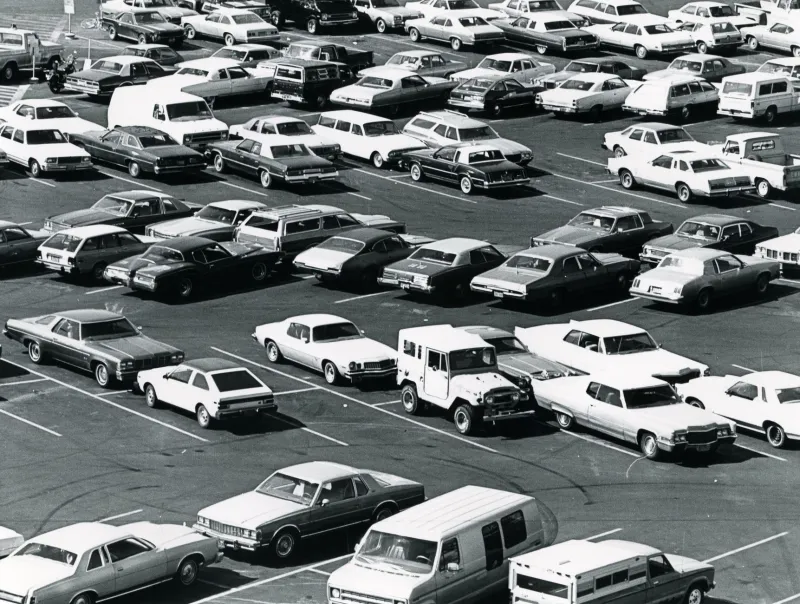
Picture a summer Saturday in 1962. You're driving down the main commercial strip of your town, and ahead of you, a car dealership has essentially transformed itself into a county fair. There are strings of colored pennants snapping in the breeze. A local radio station has parked a broadcast van on the lot and is running a live remote. A man in a straw hat is grilling hot dogs near the showroom entrance. And somewhere behind the service bay, there is, reportedly, an actual swimming pool — and whoever holds the lucky ticket gets to keep it.
This wasn't unusual. This was Tuesday. Or at least, it was the kind of thing that happened regularly enough that American families actually planned their weekends around it.
The Showroom as Destination
For much of the mid-twentieth century, car dealerships understood something that modern retailers are only now rediscovering: people need a reason to show up in person. And if the product alone isn't enough of a draw — and a car, sitting still on a lot, often isn't — you give them something else. You give them an experience.
Dealers across the country ran promotions that would seem almost absurdly generous by today's standards. Free televisions with a test drive. Washing machines raffled off to anyone who sat through a sales presentation. Trips to Las Vegas. Cash hidden inside balloons. One dealership in the Midwest became locally legendary for giving away a swimming pool — the above-ground, backyard kind — as the grand prize of a summer promotion. People came from neighboring towns just to see if it was real.
 Photo: Las Vegas, via c8.alamy.com
It was real. And it worked.
The logic was simple: get people through the gate, and your salesmen will handle the rest. But the promotions weren't just bait. They were also a form of community theater. A dealership that threw a good event was a dealership people talked about. Word of mouth in a small or mid-sized American city was everything, and nothing generated word of mouth like a spectacle.
When the Lot Was the Event
New model year reveals were perhaps the peak of this culture. Every fall, when Detroit rolled out its latest designs, dealerships would paper over their showroom windows for weeks in advance. The cars arrived under cover of night, draped in cloth. On reveal day, families dressed up and came down to see the new models the way people might go to a movie premiere today.
Some dealerships hired local bands. Others brought in magicians or clowns for the kids. A few ran actual carnival rides in their parking lots. The point wasn't just to sell cars — it was to own a moment in the community's calendar. To be the place where something happened.
Salesmen dressed the part too. These weren't guys in golf shirts and khakis. They wore suits. They knew your name, your father's name, and probably what you'd bought last time. The transaction was embedded in a relationship, and the relationship was embedded in a social occasion.
The Efficiency That Ate the Party
Somewhere along the way, the spectacle faded. It didn't vanish overnight — it eroded slowly, decade by decade, as the industry shifted its focus from experience to efficiency.
Part of the change was economic. Promotions cost money, and as margins tightened and manufacturer relationships grew more complex, the budget for free washing machines and live entertainment got redirected. Part of it was cultural. As suburban sprawl pushed dealerships out to auto rows along highways, they stopped being neighborhood institutions and became commercial stops on an errand run.
And then the internet arrived and changed everything. By the time most Americans had broadband at home, the dealership visit had already transformed from an occasion into an obligation. You researched the car online. You knew the invoice price before you walked in. You wanted to get in, negotiate, and leave — not eat a hot dog and listen to a local country band.
The dealerships adapted. Showrooms became cleaner, quieter, more corporate. The pennants came down. The grills went away. The experience became frictionless in the way that modern commerce values: fast, predictable, transactional.
What Got Left Behind
There's an argument that all of this is simply progress. Nobody misses being manipulated by a high-pressure salesman in a seersucker suit. Nobody mourns the three-hour Saturday afternoon lost to a showroom floor. The ability to build your car online, lock in a price, and have it delivered to your driveway is, by almost any measure, more convenient than what came before.
But convenience has a cost that doesn't show up on the invoice. What the old dealership culture understood — even if it understood it in a cynical, promotional way — is that buying a car is a big deal. It deserved to feel like one. The balloons and the barbecue and the swimming pool giveaway were, in their own gaudy way, an acknowledgment that this moment in your life mattered. That it was worth celebrating.
Today, you can buy a car in your pajamas at midnight and have it arrive at your front door. Which is genuinely remarkable. But there's no band playing. Nobody's handing you a hot dog. And the moment you click "confirm purchase" feels about as ceremonial as ordering a new blender.
The spectacle is gone. And most of us didn't even notice it leave.