Open All Night: How Car Shopping Became a 3 AM Rabbit Hole

There's a particular kind of late-night spiral most Americans know well. You open a browser tab to check one thing, and two hours later you're deep into a forum debate about whether the 2019 Honda CR-V has a better resale value than the 2020 RAV4. Nobody planned to spend their Tuesday night that way. But that's car shopping now — boundless, relentless, and available every hour of the day.
It wasn't always like this. For most of the twentieth century, buying a car was an event. It had a time and a place, and both of those things mattered.
Sunday Afternoons and Window Stickers
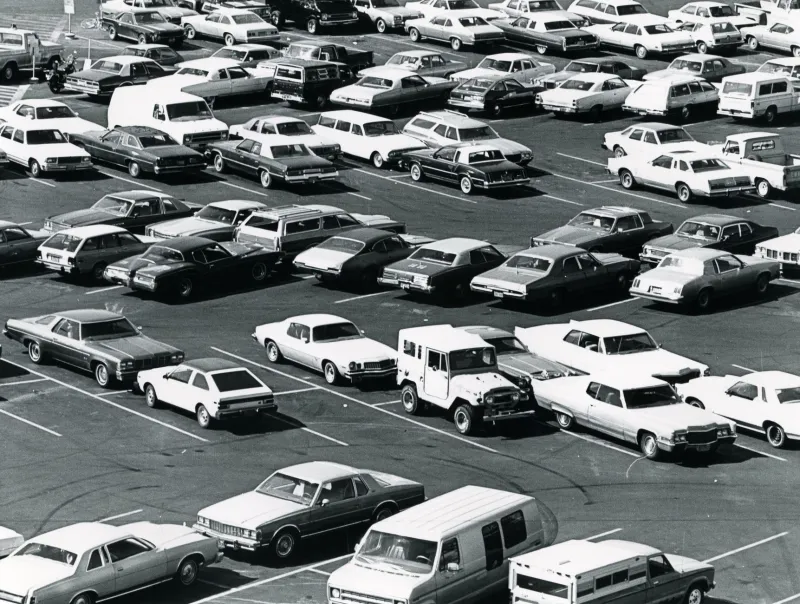
For decades, the car lot was a destination. Families would pile into their current vehicle on a weekend afternoon and cruise the dealerships just to look. Kids pressed their noses against showroom glass. Parents walked the rows of gleaming inventory, peeking through driver's-side windows at sticker prices handwritten in grease pencil. There was no hurry. No algorithm. No pop-up asking if you wanted to chat with a sales representative.
If you were serious about buying, you sat across a desk from a salesman who knew his inventory personally. He might have sold your neighbor a Buick. He probably remembered your trade-in from three years ago. The information asymmetry was enormous — dealers held all the pricing data, and buyers worked with whatever they'd clipped from the newspaper classifieds or absorbed from a friend's secondhand opinion.
The Sunday classified ads were their own ritual. Folded back to the automotive section, circled in ballpoint pen, with phone numbers jotted in the margins. You called, you talked, you made an appointment. The whole process had texture. It had friction. And for many buyers, that friction felt appropriate — a car was a major purchase, and major purchases were supposed to take effort.
The Internet Blew the Doors Off
The shift didn't happen overnight, but it happened fast once it started. By the early 2000s, sites like AutoTrader and Cars.com had begun aggregating listings in ways that gave buyers something they'd never had before: a complete picture of the market. Suddenly you could see what every dealer within 200 miles was charging for the same model. The sticker price stopped being the starting point and started being a ceiling.
Then came the reviews. Consumer Reports had existed for years, but the internet turned every owner into a critic. Forums, Reddit threads, YouTube teardowns — a buyer willing to do the homework could know more about a specific vehicle's known issues than the salesperson on the floor. That knowledge gap, which had always favored the dealer, started closing fast.
By the 2010s, most buyers arrived at dealerships having already decided what they wanted, already knowing what others had paid, and already pre-approved for financing. The showroom visit was almost a formality. The real shopping had happened on a couch, weeks earlier.
The Lot That Never Closes
Today, the experience has pushed even further. Tesla rewrote the rules entirely by eliminating dealerships from the equation — you configure your vehicle on a website, pay online, and wait for it to arrive. Carvana built a billion-dollar business on the premise that people genuinely don't want to haggle with a stranger in a polo shirt. Vroom, CarMax's online platform, and a dozen other services let buyers complete the entire transaction digitally, including trade-in appraisal, financing, and title transfer.
The virtual walkthroughs that became standard during the pandemic have largely stuck around. High-resolution 360-degree interior views, detailed video reviews, and AI-driven comparison tools mean that a buyer in rural Montana can evaluate a vehicle sitting on a lot in Atlanta before deciding whether it's worth a phone call. The friction hasn't just been reduced — for many buyers, it's been eliminated entirely.
And the shopping happens at all hours. Analytics from major automotive platforms consistently show a surge in traffic between 9 PM and midnight. People browse after the kids are in bed, after dinner is done, after the day's obligations have cleared. The lot that never closes isn't a physical place anymore. It's a browser tab.
What Was Gained, What Quietly Disappeared
The transparency is real, and it matters. Buyers who once had no choice but to trust a salesman's word can now verify every claim independently. Pricing is more competitive. Hidden fees are harder to hide when review sites and forums expose them publicly. For buyers who dreaded the high-pressure showroom environment — and plenty of people genuinely did — the shift to digital has been a genuine relief.
But something else disappeared along the way. The social dimension of car shopping — the shared experience of walking a lot with your family, the conversation with a salesman who actually knew something about the vehicles he sold, the physical act of sitting in a car and deciding whether it felt right — has been largely replaced by a solitary scroll. You can spend forty hours researching a vehicle online and never once talk to another human being about it.
There's also the paradox of choice. When the classified ads offered twenty options, the decision was manageable. When an algorithm surfaces four thousand listings filtered to your exact specifications, the decision becomes oddly harder. More information doesn't always mean more clarity.
The Gateway Has Changed
Car buying has always been one of the biggest financial decisions most Americans make. What's shifted is the gateway — the entry point to that decision, and what the journey through it actually feels like. It used to feel like an outing. Now it feels like a research project.
Both versions have their merits. The old way had warmth and community but also manipulation and opacity. The new way has power and convenience but also isolation and the peculiar exhaustion of infinite options.
Somewhere between the Sunday afternoon lot stroll and the 3 AM comparison tab, the ideal version of this transaction probably exists. Most buyers are still looking for it.