The Great American Color Fade: How Car Lots Went From a Rainbow to a Parking Lot Full of Clouds
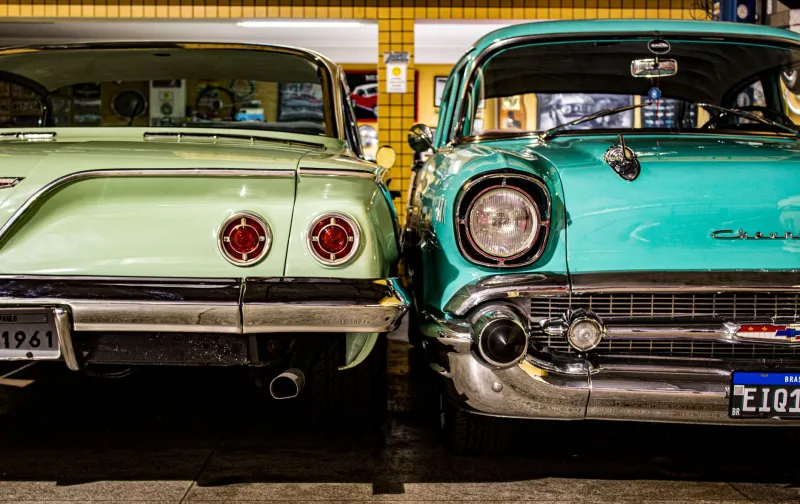
Picture a 1957 Chevrolet Bel Air in Tropical Turquoise and India Ivory. Or a 1970 Dodge Challenger in Plum Crazy Purple. Or a 1969 Ford Mustang in Grabber Green. These weren't custom paint jobs ordered by eccentric collectors — they were factory options, available to any buyer who walked through a dealership door and wanted their car to say something about them before they even turned the key.
Now walk through a dealership lot today. White. Black. Silver. Gray. Maybe a red pickup if you're lucky. The palette that once made American roads look like a traveling art show has been quietly retired, replaced by something that feels less like a choice and more like a default.
The color drained out of American cars so gradually that most people didn't notice it happening. But the shift is real, the data is clear, and the reasons behind it are more revealing than you might expect.
When Color Was a Competitive Sport
The postwar American auto industry understood something that modern manufacturers seem to have forgotten: color sells. In the 1950s, General Motors hired Harley Earl — the man who essentially invented the concept of automotive styling — and gave him a team of designers whose job was to make cars look irresistible. Color was central to that mission.
The results were extraordinary. GM's 1954 color catalog offered buyers choices like Glacier Blue, Romany Red, and Autumn Bronze. By 1957, Chevrolet was offering two-tone combinations — contrasting colors on the roof versus the body — that gave even an entry-level Bel Air a custom-built look. Ford countered with its own palette. Chrysler launched its "Forward Look" design era with fins and colors to match.
This wasn't just aesthetics. Color was a marketing tool, a status signal, and a form of self-expression. Buying a car in 1958 meant making a genuine decision about who you were and how you wanted to be seen on the road.
The muscle car era of the late 1960s pushed this even further. Dodge introduced its "High-Impact" colors — Sublime Green, Hemi Orange, Go Mango — specifically because research showed that bold colors moved inventory faster on dealer lots. The logic was simple: a car that gets noticed gets sold. Plymouth offered "Moulin Rouge" and "Vitamin C Orange." Ford gave buyers Grabber Blue and Calypso Coral.
These names weren't accidental. They were invitations.
The Great Retreat
The retreat from color began in the 1980s and accelerated through the 1990s. A few forces drove it.
First, globalization. As American manufacturers began selling the same vehicle platforms across multiple international markets, they needed colors that translated across cultures and didn't alienate buyers in Europe or Asia. White and silver were considered universally safe. Lime green was considered a risk.
Second, resale anxiety. Somewhere along the way, American buyers became acutely aware that unusual colors hurt resale value. A white car is easy to sell to anyone. A Plum Crazy Challenger has a narrower audience. As car payments stretched longer and buyers thought more carefully about their exit strategy, bold color choices started feeling like financial risks.
Third — and perhaps most significantly — the rise of leasing. When you're leasing a car for 36 months with the intention of turning it back in, you're not choosing a color that reflects your personality. You're choosing a color that the next lessee won't object to. Neutral is the rational choice when you're thinking about resale before you've even driven off the lot.
The result is visible in the data. According to PPG Industries, one of the world's largest automotive paint suppliers, white has been the most popular car color in North America for over a decade straight. In 2023, white, black, gray, and silver together accounted for roughly 80 percent of all new vehicles sold in the United States. The entire rest of the spectrum — every shade of blue, red, green, yellow, orange, and brown — split the remaining 20 percent.
What a Gray Car Actually Costs You
There's a practical consequence to all this restraint that most buyers don't consider: visibility.
Studies on traffic accidents have found that white and silver cars are among the most visible on the road in daylight conditions — but that advantage largely disappears at dawn, dusk, and in rain or fog. Gray cars, in particular, blend into overcast skies and wet pavement in ways that brighter colors simply don't. The Monash University Accident Research Centre in Australia found that white cars had a 12 percent lower crash risk than black cars in daylight, but the gap between colors narrowed or reversed in low-light conditions.
Beyond safety, there's the question of what's been lost culturally. The color of your car used to be a visible piece of personal expression. It communicated something — enthusiasm, individuality, a sense of humor. A person who drove a Hugger Orange Camaro in 1969 was making a statement. A person who drives a Magnetic Gray Metallic F-150 in 2024 is, statistically speaking, making the same statement as about 22 percent of all other F-150 buyers.
The Small Rebellion
There are signs that some buyers — and some manufacturers — are tired of the gray consensus.
Ford brought back a proper bright blue for the Bronco. Chevrolet offered Shock Yellow on the Corvette. Subaru has built an entire brand identity partly around its distinctive Wilderness Green. And the EV market has introduced some unexpected boldness — Rivian's Launch Green and Tesla's Midnight Silver Metallic both generated genuine excitement, which says something about how starved buyers are for visual variety.
Custom paint shops report increased demand from buyers who bought gray and then decided they wanted something more. Vinyl wraps — a technology that lets you change a car's color without repainting it — have become a legitimate industry partly because so many people ended up with a neutral car they're not emotionally attached to.
A Lot Full of Clouds
Stand at the edge of a busy highway in 2024 and watch the cars go by. The dominant impression is of a muted, careful, consensus-driven stream of vehicles. Occasionally something breaks through — a yellow school bus, a red fire truck, a Jeep in some vivid aftermarket color. But the private passenger vehicles blur together in shades of silver and shadow.
Then look at a photograph from a busy American road in 1965. The variety is almost startling. Coral and cream. Two-tone blue and white. Forest green. Candy apple red. The road itself looked like it was going somewhere interesting.
Maybe the cars were just reflecting the era. Maybe the era was reflected in the cars. Either way, something colorful used to move through America's streets, and whatever replaced it is considerably harder to get excited about.