The Moving Classroom: What American Kids Once Learned Just by Looking Out the Car Window
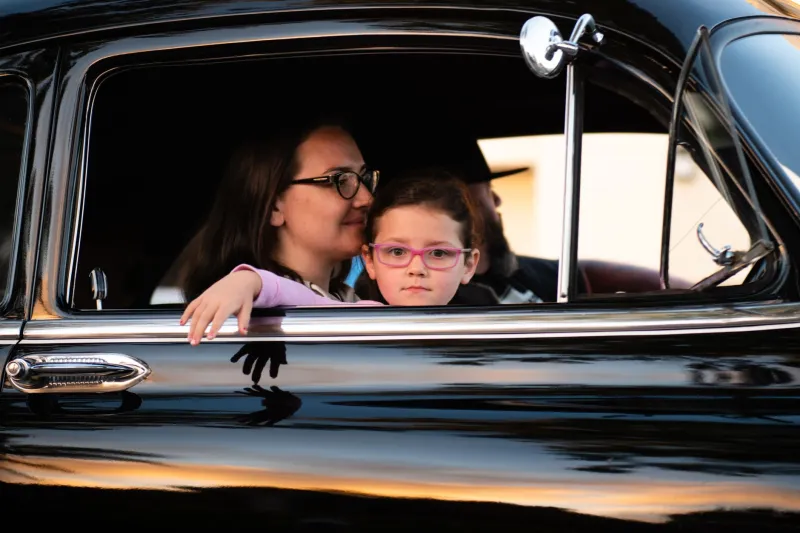
Somewhere in the American Midwest, a nine-year-old is sitting in the backseat of a station wagon, nose pressed against the glass, watching the flat land scroll past. Her father is driving. Her mother is reading a paperback. Her brother is asleep. The radio is playing something nobody chose. And she is learning.
Not formally. Nobody assigned this. There's no worksheet and no grade. But she's watching the grain elevators rise and fall on the horizon, counting the miles between water towers, noticing how the highway signs change their typography as you cross from one state into the next. She's building a mental map of the country that she'll carry for the rest of her life — one exit, one landmark, one long empty stretch at a time.
This is what car travel used to do to children. It educated them sideways, without anyone intending it.
The Geography Lesson Nobody Planned
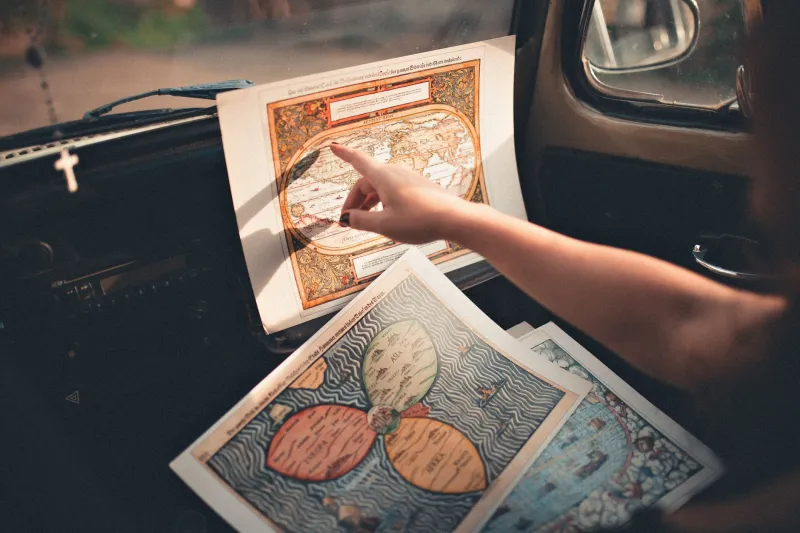
Before GPS made navigation a spectator sport, someone in the car had to actually know where you were going. On long family trips, that responsibility often fell — partly, informally — to the kids. A parent would hand a folded road atlas to the backseat and ask for a mileage check. How far to the next big city? What's the name of this river we're crossing? Which highway do we take when we get to the junction?
These weren't trick questions. They were genuine requests for information. And answering them required a child to actually read a map — to understand scale, to trace routes, to interpret the color-coded tangle of interstates and state roads and county highways that covered every page.
Map literacy sounds like a small thing until you consider what it actually requires: spatial reasoning, the ability to translate a two-dimensional representation into a three-dimensional understanding of physical space, and a grasp of proportion and distance that isn't intuitive. Children who grew up reading road atlases developed these skills without realizing they were developing them. It was just something you did when you were bored in the backseat and someone handed you the Rand McNally.
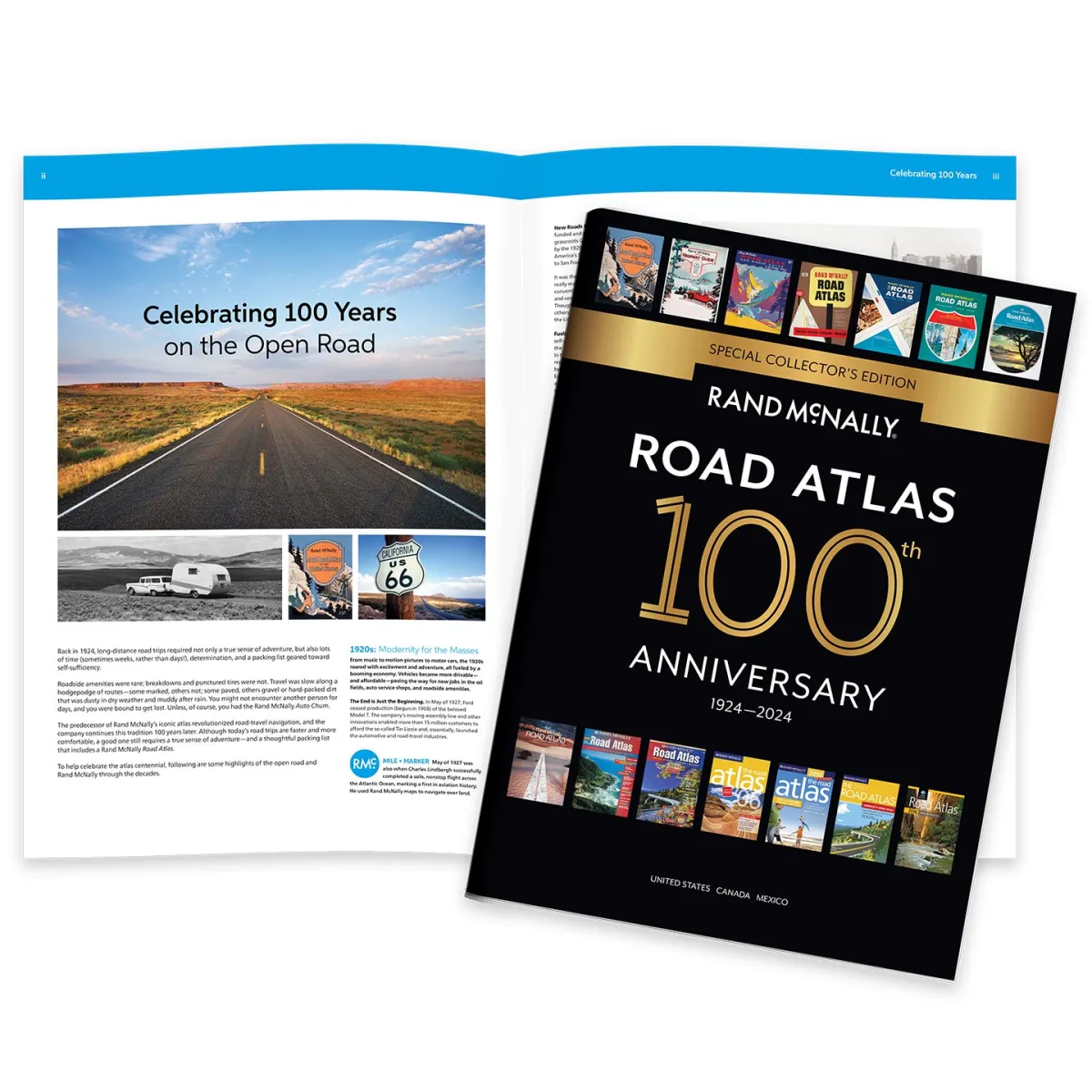 Photo: Rand McNally, via help.randmcnally.com
License Plates and the Expanding World
If the atlas was the textbook, license plate games were the geography quiz. Every family had a version. Some kept running tallies on paper. Others used laminated cards with every state listed. The goal was always the same: spot a plate from as far away as possible. Alaska. Hawaii. Vermont. Rhode Island.
What made this game quietly educational wasn't the competition — it was the conversation it started. A plate from Montana prompted a question about where Montana was, which led to a discussion of what was there, which led, sometimes, to a detour through a family story about a relative who'd once passed through Billings or a news story one parent half-remembered about Glacier National Park.
 Photo: Glacier National Park, via morethanjustparks.com
The country revealed itself this way — not as a set of facts to memorize but as a collection of places that were real, that people actually came from, that had their own weather and terrain and reasons for existing. A child who spent enough summers in the backseat playing license plate games developed an intuitive sense of American geography that no classroom map exercise quite replicated.
Reading the Road Itself
There was also the landscape. This sounds obvious — of course you can see the landscape from a car window — but seeing and reading are different things. Kids who grew up on long drives before screens became standard equipment learned, almost unconsciously, to interpret what they saw.
The change in vegetation as you moved from one climate zone to another. The way the architecture of gas stations and diners shifted between regions. The moment you crossed from the humid green of the Southeast into the drier palette of the Southwest. The way mountains announced themselves on the horizon hours before you reached them. The difference between a river town and a railroad town, visible in the layout of the streets even from the highway.
None of this was taught. It was absorbed. And absorption requires attention — the kind of slow, wandering attention that only boredom produces. Kids on long car rides got bored. And boredom, in the absence of a screen to fill it, turned outward. It became curiosity about the world passing by.
The Screen That Closed the Window
The first in-car DVD players appeared in the late 1990s. By the mid-2000s, the backseat entertainment system had become a standard feature on minivans and SUVs. Today, children travel with tablets loaded with movies, streaming services accessible through the car's Wi-Fi hotspot, and wireless headphones that seal them inside their own private audio world.
None of this is malicious. Parents who hand a child a tablet on a long drive are solving a real problem: a bored, restless child in a moving vehicle is genuinely difficult. The screen is a solution that works. It keeps kids calm, keeps arguments down, and makes the miles easier for everyone.
But it also closes the window — not physically, but experientially. A child watching a movie in the backseat of a car crossing Kansas isn't learning anything about Kansas. They're not building a mental map. They're not reading the horizon. They're not developing the patience that comes from having nothing to do but look at the world.
The miles still pass. They just pass unnoticed.
What the Long Drive Gave Us
The adults who grew up in backseats without screens often describe their childhood road trips with a vividness that's striking. Not just the destinations — the journeys themselves. The particular quality of light over the desert at four in the afternoon. The smell of the air when you cracked the window somewhere in Tennessee. The strange comfort of falling asleep to the sound of the highway and waking up in a different state.
These aren't just memories. They're the residue of attention paid to the physical world over long, uninterrupted stretches of time. That kind of attention builds something — a relationship with place, a tolerance for uncertainty, a curiosity about what's around the next bend.
We didn't design that curriculum. It arose naturally from the conditions of the journey: no screens, a big country, and a window with nothing to do but look through it.
The country is still big. The windows are still there. But the looking has mostly stopped — and with it, one of the quietest and most effective educations America ever accidentally provided.