The Last Backseat Navigator: When Getting There Was a Team Sport
Ask anyone who grew up road-tripping in the 1970s, '80s, or '90s about their most vivid travel memories, and the odds are good that at least one of them involves an argument. Not a serious argument. The specific kind of argument that only happens inside a moving car, somewhere between a highway exit you may or may not have just missed and a gas station that was supposed to be on the right but definitely wasn't.
That argument had a co-star: the navigator. Usually a parent, sometimes an older sibling, occasionally a spouse who had very specific ideas about shortcuts. They held the map. They held the power. And they were not shy about using either.
The Map Was a Relationship Test
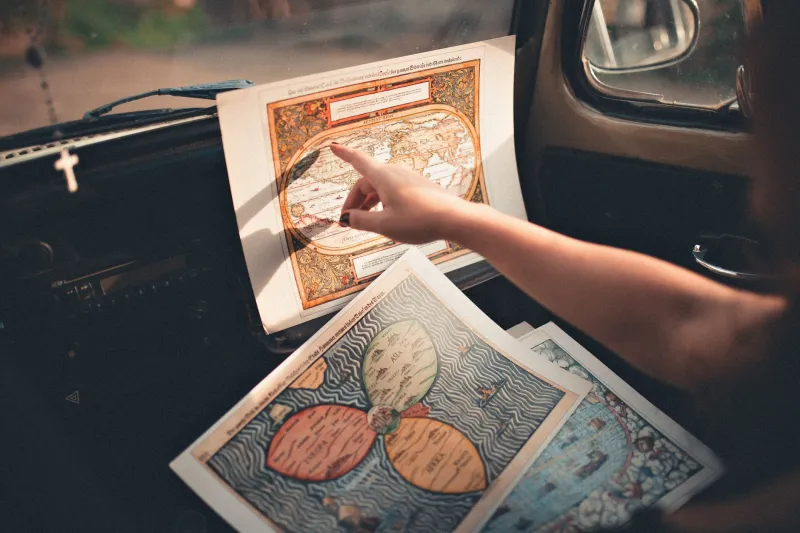
Folded road maps were not user-friendly objects. They opened easily enough, but refolding them was a puzzle that seemed designed to humiliate. They were large, unwieldy, and prone to tearing at the creases after a few seasons of use. State maps from AAA were slightly better — crisper, more current — but they still required a certain patience to read in a moving vehicle, especially when the sun was hitting them at the wrong angle and the driver was asking questions faster than you could find the answers.
The navigator's job was genuinely skilled work. You had to track your current position while anticipating what was coming, convert map distances into real-world time estimates, and communicate all of that clearly to a driver who might be simultaneously managing lane changes, a crying toddler, and an opinion about whether to stop for lunch now or push through to the next town.
When it worked, it was a kind of quiet teamwork that road trips ran on. When it didn't, the car became a very small room with no exit.
What the Wrong Turn Actually Gave You
Here's the thing about wrong turns that nobody talks about anymore: they were occasionally the best part of the trip.
Take the wrong exit in 1988 and you might end up driving through a small town you'd never heard of, past a diner with a hand-painted sign and a parking lot full of locals, or alongside a river that wasn't on the itinerary but was genuinely beautiful. There was no system recalculating. No voice telling you to make a legal U-turn. There was just the road in front of you and the decision about what to do with it.
Families stumbled onto roadside attractions that way. Drive-in burger stands. State parks without entry fees. Scenic overlooks that weren't marked on any map because they didn't need to be — you could see them from the highway. The wrong turn wasn't always a failure. Sometimes it was an accidental detour into the best story you'd tell from the trip.
That kind of discovery required being slightly lost. And being slightly lost required a navigation system that was human enough to make mistakes.
The Passenger Seat Goes Quiet
GPS changed the passenger seat's job description fundamentally. The first generation of navigation devices — the Garmin and TomTom units that suction-cupped to windshields in the mid-2000s — didn't just provide directions. They made the co-pilot redundant. The map stayed in the glove box. The arguments about exits stopped. The wrong turns became rarer.
Smartphone navigation finished the transformation. By the early 2010s, Google Maps and Waze had absorbed the navigator's entire function into a pocket device that spoke calmly, recalculated silently, and never once accused anyone of not paying attention at the last junction.
The passenger seat, freed from its navigational duties, became a screen-watching seat. The co-pilot became a passenger. And road trips, which had always been partly about the process of figuring out where you were going together, became something closer to a scheduled transit experience — efficient, frictionless, and oddly quiet.
The Conversation That Used to Happen
Navigation wasn't just functional. It was conversational. The act of reading a map together, debating routes, deciding whether to take the interstate or the state highway — all of that generated talk. Real talk, about real choices, with real stakes. The kind of conversation that doesn't happen when a screen has already made the decision for you.
Kids in the back seat absorbed geography by osmosis. They heard their parents discuss distances and landmarks. They learned that Columbus was roughly halfway between Pittsburgh and St. Louis, not because anyone taught them that, but because they'd heard it said out loud in a moving car while staring at a map spread across the center console. That kind of incidental learning is hard to replicate when the route is invisible and the destination is just a dot on a glowing screen.
 Photo: St. Louis, via 1gr.cz
There's also something to be said for the shared ownership of the journey. When two people are navigating together, both of them are invested in where the car ends up. When one person delegates entirely to an app, the other is just along for the ride. The trip belongs to the device, not the people in the car.
Precision at a Price
Nobody is seriously arguing that GPS isn't useful. It is. Dramatically so. It has reduced the stress of driving in unfamiliar cities, eliminated the particular panic of being lost in the dark in a neighborhood you don't recognize, and made solo road trips genuinely more manageable for millions of people.
But precision has a price. The frictionless journey is also a less memorable one. When everything goes according to the algorithm, the trip becomes a series of confirmed predictions rather than a collection of experiences. You arrive exactly where you intended, exactly when you expected to. And you have almost nothing interesting to say about how you got there.
The last backseat navigator — the one with the map, the opinions, and the occasional wrong call — wasn't just finding the route. They were making the trip worth talking about afterward. That's a job no app has figured out how to do.