Fold It, Fight It, Find Your Way: The Lost American Ritual of the Road Map
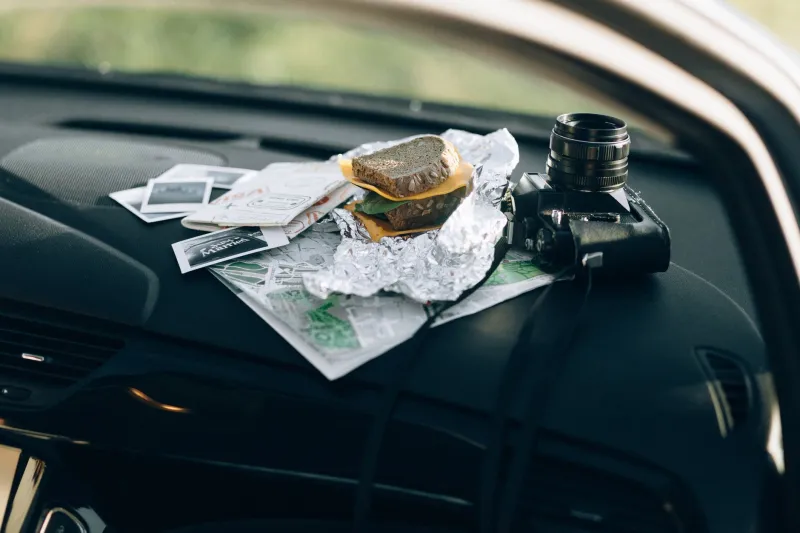
There was a particular kind of frustration that belonged exclusively to road trips before the smartphone era. You'd be somewhere in the middle of Ohio, the sun dropping fast, and someone in the passenger seat would be wrestling a full-size highway map back into its original fold — a fold it had clearly never successfully returned to since leaving the gas station rack. Arguments started over maps. Marriages were tested by maps. And somehow, people still got where they were going.
Today, a soft voice from your phone tells you to turn left in 400 feet, and you do. No paper. No argument. No detour. It's efficient, clean, and completely unremarkable. But something that used to be a genuine skill — and a genuine experience — has quietly disappeared from American road culture, and most of us haven't stopped to notice.
The Map as a Physical Object
Paper road maps were never just functional. They were artifacts. Gas stations gave them away free for decades — Esso, Gulf, Texaco — and millions of American families accumulated stacks of them in glove compartments, stuffed into door pockets, folded and refolded until the creases became tears. AAA members received them by mail. Rest stops offered them in wire racks near the vending machines.
A well-used map told a story. Highlighted routes in yellow marker. Handwritten notes in the margins — good diner here, road construction, Aunt Carol's exit. Coffee stains from early mornings. A fold worn completely through at the intersection of Route 66 and somewhere you'd driven a hundred times. These weren't just navigation aids. They were personal documents.
Rand McNally published its first road atlas in 1924, and by the mid-twentieth century, the company was printing tens of millions of copies annually. The spiral-bound Rand McNally Road Atlas became as American as the road trip itself — a staple in every family station wagon, every long-haul trucker's cab, every college student's beat-up sedan.
Spatial Awareness Was a Skill
Here's the thing about reading a paper map that nobody really talks about anymore: it required you to understand where you were in relation to everything else. You had to orient yourself. You looked at the map, you looked at the road, you built a mental picture of the landscape around you. You knew you were heading northwest because the sun was on your left and fading. You understood that the next big town was about sixty miles ahead because you'd measured it against the scale bar with your thumb.
That kind of spatial reasoning — the ability to translate a flat image into real-world movement — was something Americans quietly practiced every time they took a long drive. Kids in the backseat learned it by watching. Teenagers sharpened it on their first solo trips. It was a navigational literacy that got passed down without anyone really calling it that.
GPS didn't just replace the map. It replaced the mental process behind using one. Turn-by-turn navigation reduces the entire journey to a single instruction at a time. You never need to understand where you are — only what to do next. Studies in cognitive geography have suggested that heavy GPS reliance can actually reduce people's ability to build mental maps of familiar areas. We've traded spatial understanding for step-by-step compliance.
Getting Lost Used to Be Part of the Deal
Ask anyone who took road trips before 1995 about getting lost, and you'll usually get a smile before the story. Because getting lost — genuinely, productively lost — was how you found things. A wrong turn outside Asheville led to a waterfall nobody in the car had heard of. A missed exit in the Texas Hill Country turned into an unplanned overnight in a town with the best barbecue anyone had ever eaten.
The map didn't prevent detours. It just meant that detours had consequences — you had to figure out where you ended up and recalculate from there, using nothing but the map, a road sign, and your own best judgment. That process of recovery, of orienting yourself and finding a new route, was genuinely satisfying in a way that "recalculating" never quite manages to be.
There's a reason so many great American road trip stories involve getting lost. It's where the interesting stuff happened.
The Passenger Had a Job
One of the most underrated losses in the GPS era is the role of the navigator. In every car, on every long trip, there was someone whose job it was to manage the map. They tracked progress, called out upcoming exits, warned about construction zones marked with little road symbols, and occasionally had to hold the map up to the window to catch enough light to read it after dark.
It was a genuine co-pilot role. The driver drove. The navigator navigated. You were a team. GPS collapsed that partnership into a single voice coming from a dashboard mount, and the passenger — freed from all responsibility — picked up their phone and checked Instagram instead.
The shared experience of figuring out where you were going, together, is something that's hard to quantify as a loss. But it was real.
What We Traded and What We Got
Nobody is seriously arguing that we should go back to paper maps. GPS is genuinely better at getting you from point A to point B without incident. It reroutes around traffic in real time. It knows about the road closure that happened an hour ago. It tells you exactly how long until you arrive. For pure logistics, it wins.
But the map offered something the GPS doesn't: context. With a paper map spread across your lap, you knew the whole picture. You could see the alternate routes, the scenic byways, the small towns you might want to stop in. You were in conversation with the landscape, not just following orders through it.
The last Rand McNally Road Atlas still sells. You can find it at truck stops and bookstores. Some people still buy them — long-haul drivers, off-road enthusiasts, people who like knowing the whole picture. But for most Americans, the map is a nostalgic curiosity now, like a rotary phone or a paper boarding pass.
The road is still out there. The journey is still happening. We've just stopped reading it.