Keys, Cash, and the Open Road: When Car Rentals Meant Adventure Instead of Anxiety
The Two-Minute Transaction
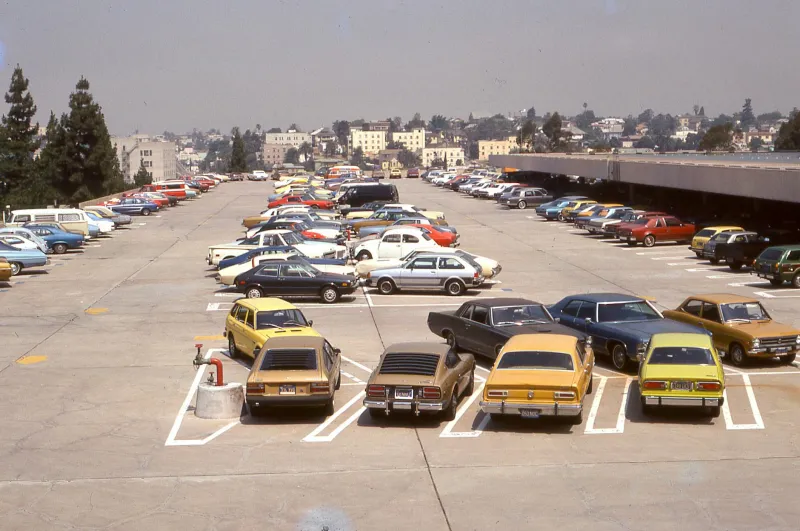
In 1972, renting a car at Los Angeles International Airport took about as long as ordering a hamburger. You'd walk up to the Hertz or Avis counter, show your driver's license, hand over a credit card or cash deposit, and receive a set of keys attached to a simple plastic tag. The entire transaction might involve a single page of paperwork—if that.
 Photo: Los Angeles International Airport, via www.e-obrazy.cz
"What kind of car would you like?" the agent would ask, gesturing toward a lot full of possibilities. "Compact, mid-size, or full-size?" No mention of liability waivers, supplemental insurance, or fuel policies. No discussion of GPS units, satellite radio, or roadside assistance packages. Just keys, a handshake, and the assumption that you'd bring the car back in roughly the same condition you found it.
The rental lot itself felt like a used car dealership where everything was for temporary sale. Cars sat with their keys in the ignition, doors unlocked, ready for immediate departure. The biggest decision you faced was choosing between a Chevrolet Impala and a Ford Galaxy, both priced at around $8 per day with unlimited mileage.
Trust as the Default Setting
The entire system operated on a foundation of mutual trust that seems almost quaint today. Rental companies trusted customers to drive responsibly, return vehicles on time, and pay for any damage they caused. Customers trusted rental companies to provide reliable vehicles and fair pricing without hidden surprises.
This trust manifested in practical ways that would horrify modern risk managers. Many rental locations didn't even inspect vehicles when they were returned—they'd simply check the odometer and fuel level, then send you on your way. The assumption was that honest people would report any problems, and dishonest people were rare enough to absorb as a cost of doing business.
Damage disputes were often settled through conversation rather than litigation. If you returned a car with a small dent, the agent might ask what happened, assess the repair cost, and add it to your bill. No photo documentation, no insurance claims, no armies of adjusters. Just human judgment applied to human problems.
The Paperwork Revolution
The transformation began in the 1980s as rental companies grew larger and more corporate. What started as mom-and-pop operations serving local airports evolved into national chains managing thousands of vehicles across multiple states. With scale came standardization, and with standardization came paperwork—lots of it.
Insurance became the first complicating factor. As lawsuit settlements grew larger and more frequent, rental companies began pushing supplemental coverage with increasing urgency. The simple question "What kind of car?" was replaced by a complex decision tree involving collision damage waivers, liability supplements, and personal accident insurance.
Each additional coverage option required explanation, disclosure, and documentation. The two-minute rental transaction stretched into a fifteen-minute insurance seminar, complete with legal disclaimers and risk assessment questionnaires.
The Birth of Rental Anxiety
Somewhere in the 1990s, renting a car stopped feeling like an adventure and started feeling like a minefield. Companies began implementing increasingly elaborate damage inspection procedures, documenting every scratch, dent, and scuff with military precision. Customers found themselves walking around vehicles with rental agents, pointing out existing damage to avoid being charged for it later.
Fuel policies became Byzantine exercises in frustration. The simple "return it with the same amount of gas" evolved into multiple options: prepay for fuel at inflated prices, return it full and risk being charged anyway, or pay refueling fees that seemed designed to generate revenue rather than cover actual costs.
Additional driver fees, GPS rental charges, satellite radio subscriptions, and roadside assistance packages turned the rental counter into a high-pressure sales environment. What once felt like a service transaction began to resemble a timeshare presentation.
Technology as Complication
The digital revolution promised to simplify car rentals but often had the opposite effect. Smartphone apps and online check-in procedures were supposed to streamline the process, but they frequently created new layers of complexity. Customers now navigate multiple screens of insurance options, vehicle upgrades, and add-on services before ever setting foot on a rental lot.
The vehicles themselves became more complicated. Modern rental cars arrive with touchscreen interfaces, Bluetooth connectivity issues, and dozens of electronic systems that previous generations never had to navigate. What used to be a simple matter of adjusting the seat and mirrors now involves programming phone connections and deciphering infotainment systems.
The Fine Print Explosion
Today's rental agreements read like legal documents because that's essentially what they've become. Pages of terms and conditions cover everything from acceptable driving locations to social media usage policies. The trust-based handshake agreements of the past have been replaced by comprehensive liability shields designed to protect companies from every conceivable risk.
Customers sign documents they don't understand, agreeing to terms they haven't read, and accepting responsibility for scenarios they can't imagine. The rental process has become less about facilitating travel and more about managing legal exposure.
When Freedom Had Four Wheels
The old rental car experience embodied a particular vision of American freedom—the ability to arrive somewhere new and immediately have access to mobility without bureaucratic hassles or financial anxiety. You could fly into Miami, rent a convertible, and drive to Key West without worrying about fuel policies or damage documentation.
 Photo: Key West, via celebritate.com
That spontaneous mobility extended beyond just getting around. Rental cars enabled impromptu road trips, last-minute business travel, and the kind of flexible itineraries that modern rental policies seem designed to discourage. The administrative overhead was minimal enough that short-term rentals made sense for everything from moving furniture to impressing a date.
The Anxiety Economy
Modern car rentals operate in what might be called the anxiety economy—a business model that generates revenue through customer uncertainty and confusion. The proliferation of fees, policies, and procedures serves multiple purposes: it protects companies from liability, creates additional revenue streams, and shifts risk back to customers.
The result is a rental experience defined more by what might go wrong than what should go right. Customers approach rental counters with defensive strategies rather than travel excitement, armed with smartphone cameras to document pre-existing damage and calculator apps to decipher fuel policies.
Progress and Its Discontents
Today's rental cars are undeniably better vehicles—safer, more reliable, more fuel-efficient, and equipped with features that would have seemed like science fiction to travelers in 1972. The reservation systems are more sophisticated, the fleet management is more efficient, and the customer protections are more comprehensive.
But the experience itself has become exponentially more stressful. What once took minutes now takes hours. What once required trust now demands documentation. What once felt like freedom now feels like a legal transaction with wheels attached.
The Road Back to Simplicity
The transformation of car rentals from simple to complex reflects broader changes in American business culture—the shift from relationship-based commerce to risk-managed transactions, from human judgment to algorithmic decision-making, from trust to verification.
Some newer rental companies are attempting to recapture the simplicity of the past through technology, offering app-based rentals with minimal human interaction and simplified pricing. But they're swimming against decades of industry evolution that prioritized protection over experience.
The rental car counter once represented the beginning of an adventure—a place where possibilities opened up and the road beckoned. Today, it feels more like the final obstacle between travelers and their destinations, a necessary friction rather than an enabling service. The keys still unlock the same freedom, but the path to getting them has become a journey unto itself.