Twenty Days in a Model T: The Coast-to-Coast Trip That Used to Eat a Month of Your Life
In the summer of 1919, a young Army officer named Dwight Eisenhower joined a convoy of 81 vehicles tasked with crossing the United States by road. The trip took 62 days. Trucks sank into mud in Nebraska, bridges collapsed under their weight in Wyoming, and the convoy averaged about 6 miles per hour across parts of the route. Eisenhower never forgot it — and three decades later, as president, he signed the bill that made sure nobody would ever experience the country that way again.
When the Map Was Mostly a Guess
If you wanted to drive from New York to San Francisco in the 1930s, you needed preparation that looked more like planning an expedition than booking a trip. The Lincoln Highway, the first transcontinental route, existed — but 'existed' is generous. Long stretches were gravel or plain dirt. In wet weather, drivers carried chains, shovels, and sometimes planks to wedge under tires in axle-deep mud.
A typical coast-to-coast drive in that era took roughly 20 days of actual travel. Motoring guides like the famous 'Auto Trails' maps advised travelers to budget a full month, factoring in breakdowns, washed-out roads, and the simple reality that you couldn't average more than 200 miles a day without punishing both your car and your back.
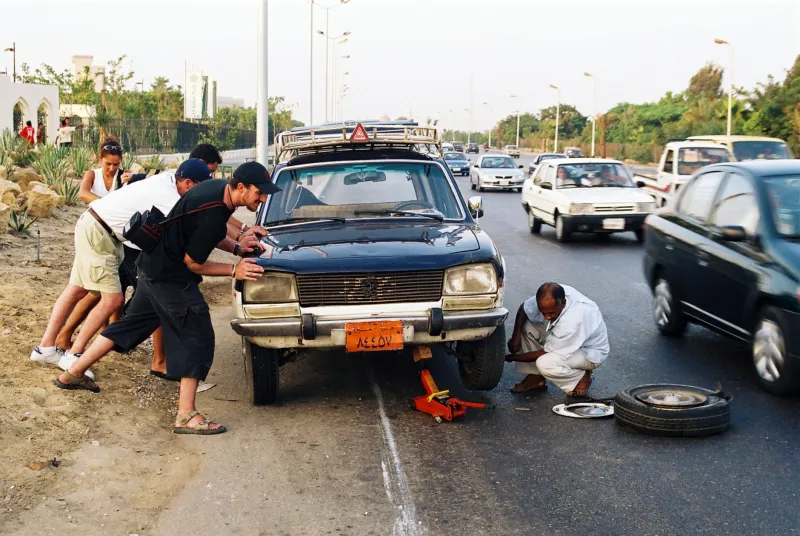
Fuel? You planned your day around the towns that had gas stations, because stretches of the West offered none for 100 miles or more. Tires blew out with such regularity that a cross-country driver could expect to patch or replace several before reaching the Pacific.
Motels, Diners, and the Economy of the Slow Road
Here's what's easy to forget: all that slowness built an entire civilization along the roadside.
Every small town along a major two-lane highway lived or died by the traffic passing through. Motor courts — the precursors to motels — sprang up in the 1920s and 1930s, offering cabins where families could park the car right outside the door. Diners, curio shops, alligator farms, 'world's largest' ball-of-twine attractions: the slow road made every mile a potential stop, because stopping was mandatory anyway.
Route 66 became the most famous example, but it wasn't unique. In Colorado, Kansas, Pennsylvania, and everywhere in between, the highway itself was Main Street's economic engine. A gas station, a café, and a place to sleep could keep a family business alive for generations.
Eisenhower's Revenge
The Federal-Aid Highway Act of 1956 changed everything, and it changed it fast. Inspired partly by his 1919 convoy experience and partly by the German Autobahn, Eisenhower championed a 41,000-mile network of limited-access highways that would eventually touch every corner of the country.
The numbers tell the story. By the 1970s, a determined driver could cross the country in about four days. Today, with cruise control set and coffee in hand, New York to Los Angeles is a five-day casual drive — or a 41-hour sprint if you swap drivers and don't sleep much. That's a compression of roughly 80 percent from the 1930s pace.
Uniform 12-foot lanes, gentle curves, no intersections, no farm tractors puttering at 15 miles per hour. The Interstate didn't just make driving faster; it made it predictable. You always knew what the next 500 miles would look like.
What Vanished in the Rearview Mirror
Predictability had a price. When the new highways bypassed the old routes, they bypassed the businesses too. Whole towns that had lived off highway traffic withered once the exit ramp pointed elsewhere. The famous motels and diners of Route 66 became nostalgic landmarks precisely because the economic machine that sustained them was switched off.
Something cultural faded as well. The 20-day trip wasn't just slow — it was immersive. You saw the country at the speed of a hay wagon because you had no choice. Every meal was local, every overnight stay was in a town you'd never heard of. Today's cross-country driver can pass through six states eating at the same chain restaurant and sleeping in the same hotel room each night.
There's a case to be made that both things are true: the Interstate is one of the greatest public works achievements in human history, and it also flattened a certain kind of American experience. Families in 1935 arrived in California exhausted, broke, and full of stories. Families in 2025 arrive rested and full of podcasts.
The Country Didn't Shrink — Our Access to It Did
Next time you drive across a state line in an afternoon without thinking twice, consider what that gesture would have meant to a traveler in 1935. They'd have spent a week just getting to that sign.
The distance between our coasts has never changed — about 2,900 miles, give or take. What changed is how much of our lives that distance gets to consume. A month of planning and mud and patched tires became a five-day cruise and a playlist. Whether that's pure progress or a trade we made without fully noticing is the kind of question that only shows up when you take the old two-lane road — the one running parallel to the Interstate — and see what's still standing there.